Sermorelin 5 mg Research Peptide | Pure Lab Peptides Supply
Description
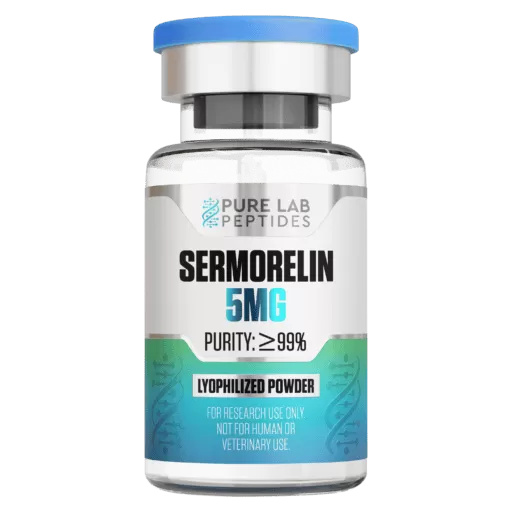
Sermorelin 5 mg
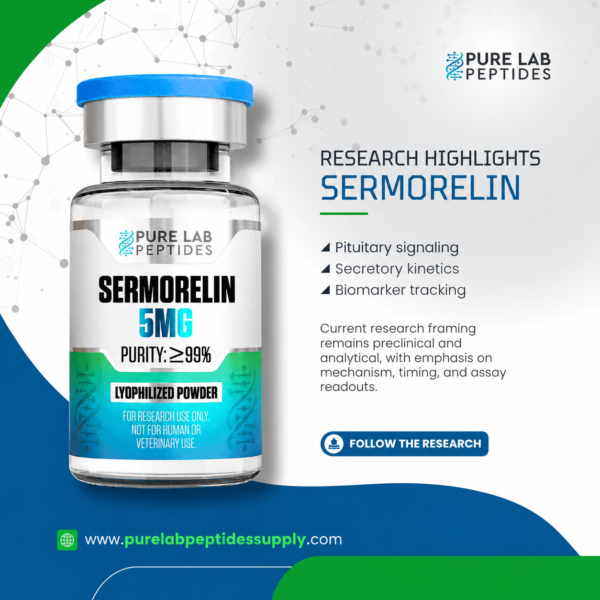
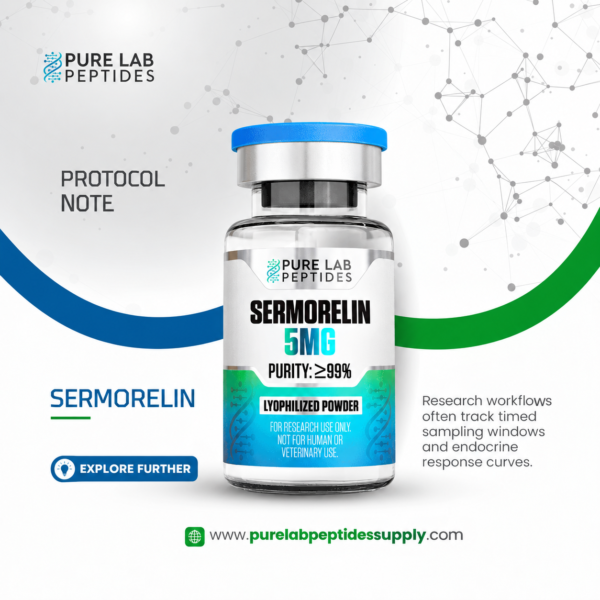
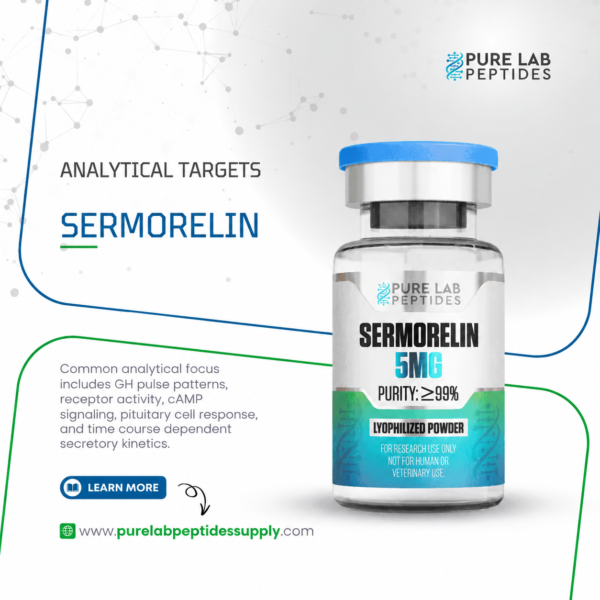
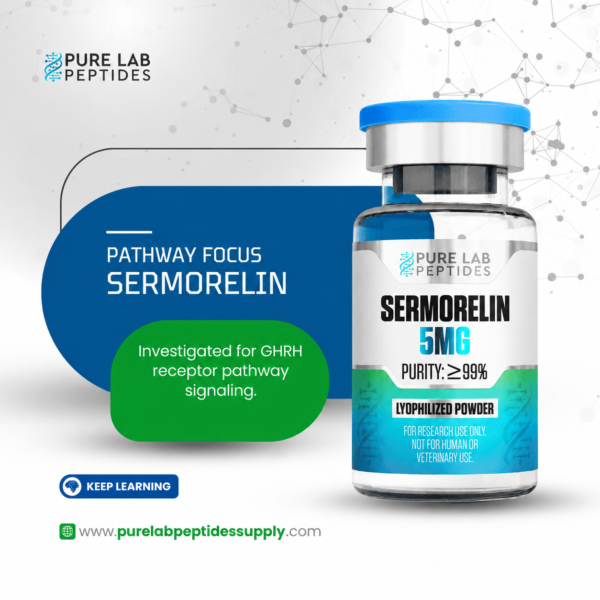
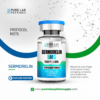
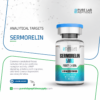
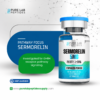
Buy Sermorelin 5 mg from Pure Lab Peptides Supply for laboratory research and analytical evaluation. Each listing describes lyophilized powder supplied in one boxed 3 mL vial.
Sermorelin is a synthetic peptide corresponding to the first 29 amino acids of growth hormone-releasing hormone (GHRH). Researchers study this fragment in relation to GHRH receptor signaling and growth hormone regulation. However, Sermorelin, tesamorelin, modified CJC-related peptides, and growth hormone itself represent distinct molecules. Therefore, researchers should confirm the identity and structure of the material required for their method.
Choose the Correct Material and Presentation
Pure Lab Peptides Supply may offer Sermorelin in different labeled quantities, including a separate Sermorelin 10 mg presentation. Compare the product labels and applicable documentation before choosing a research material.
Although two presentations may contain the same named peptide, the labeled quantity alone does not confirm identity, purity, or analytical performance. Likewise, a 3 mL vial describes container capacity rather than solution concentration or preparation volume.
For reliable comparisons, check the complete sequence, chemical form, and available batch documentation. In addition, distinguish Sermorelin from other GHRH-related compounds because structural differences can affect how researchers interpret analytical results.
Sermorelin and GHRH-Fragment Identity
Analytical research has examined methods for distinguishing intact Sermorelin from its degradation products. In one study, researchers used antibodies to capture GHRH-related peptides from plasma before applying high-resolution tandem mass spectrometry. They then monitored intact Sermorelin and a shortened metabolite, GRF(3–29), separately.
The researchers also observed a decrease in intact Sermorelin during incubation in human plasma as degradation progressed. Therefore, the findings highlight the importance of distinguishing the starting peptide from related degradation products when designing an analytical method.
However, these plasma-assay observations do not establish the shelf life of a lyophilized vial or a prepared solution. Those questions require suitable stability studies under defined storage and testing conditions.
Research Applications and Analytical Context
Researchers may examine Sermorelin in laboratory workflows involving peptide identity and analytical method development. Depending on the study design, relevant areas may include:
- Peptide identification: Assess whether an analytical method can distinguish Sermorelin from related peptides.
- Degradation analysis: Investigate the formation of peptide-related degradation products under defined experimental conditions.
- Mass spectrometry: Evaluate suitable approaches for detecting and characterizing the target peptide.
- Method development: Review sample preparation, analytical specificity, and measurement performance.
- GHRH-related research: Explore the scientific literature concerning the structure and signaling context of GHRH fragments.
These applications describe research areas rather than guaranteed outcomes. Actual results depend on the material, analytical method, sample conditions, and measured endpoints.
Product Specifications
- Product name: Sermorelin 5 mg
- Labeled quantity: 5 mg
- Material type: Synthetic GHRH-related peptide
- Format: Lyophilized powder
- Packaging: One boxed 3 mL vial
- Peptide identity: Sermorelin, corresponding to the first 29 amino acids of GHRH
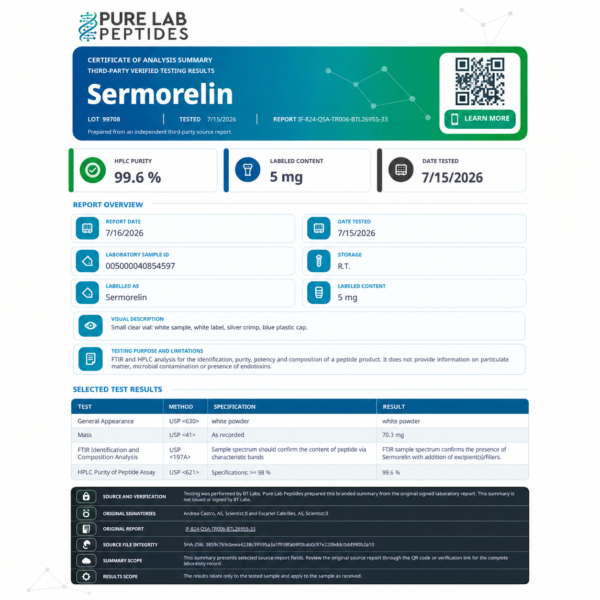
- Purity: Check the applicable batch documentation for the reported result
- Molecular formula: Confirm using the current product documentation
- Molecular weight: Confirm using the current product documentation
- Research applications: Peptide identification, degradation analysis, mass spectrometry, and analytical method development
- Storage and stability: Follow the instructions applicable to the supplied material
- Safety information: Consult the available product documents and relevant safety information
- Intended use: Laboratory research only
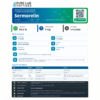
Specification note: The supplied information does not include a batch-specific purity result, molecular formula, or molecular weight. Therefore, this page does not assume those values or substitute specifications from another presentation.
Review Product Documents and Batch Reports
Before using Sermorelin 5 mg in an analytical workflow, review the available product files and compare the vial label with the applicable batch record. Then, assess identity, purity, and measured content separately because each result answers a different question.
A purity percentage alone does not confirm the complete identity of a peptide. Similarly, a published study provides scientific context but does not independently verify the quality or performance of a commercial batch.
For available records, visit the COA and product documentation page. You can also visit Pure Lab Peptides Supply for additional product information.
Storage, Handling, and Research Use
Follow the current technical documentation for storage, handling, and solvent compatibility. In addition, confirm whether the available stability information applies to the lyophilized material, a prepared solution, or both.
Do not infer the shelf life of a vial from a plasma degradation study. Instead, rely on material-specific evidence and follow your laboratory’s safety procedures.
Frequently Asked Questions
What is Sermorelin 5 mg?
Sermorelin 5 mg is listed as a synthetic GHRH-related research peptide supplied as lyophilized powder in one boxed 3 mL vial. Researchers should check the applicable product documentation to confirm the material’s specifications.
How does Sermorelin differ from growth hormone?
Sermorelin is a peptide fragment related to GHRH, whereas growth hormone is a separate protein. Consequently, researchers should not treat the two molecules as interchangeable analytical materials.
Is Sermorelin the same as tesamorelin or CJC-related peptides?
No. These are distinct compounds with different structural features. Therefore, researchers should confirm the complete identity of each material before comparing specifications or analytical results.
Does the 5 mg label indicate solution concentration?
No. The label states the listed quantity of material, while the 3 mL figure describes vial capacity. Neither specifies the concentration of a prepared solution.
Does plasma degradation research establish product shelf life?
No. Findings from an incubated plasma sample do not establish the stability of lyophilized material or a prepared solution. Researchers need suitable stability evidence for the specific material and storage conditions.
Where can I find the available product records?
Visit the COA and product documentation page to review available records. Check that the documentation corresponds to the product and batch under evaluation.
Explore Sermorelin 5 mg Research Material
Explore Sermorelin 5 mg from Pure Lab Peptides Supply for laboratory research and analytical evaluation. Before ordering, review the available documentation and confirm the product identity, labeled quantity, and relevant technical specifications.
Visit Pure Lab Peptides Supply or consult the COA and product documentation page for further information.
For laboratory research only. Not for human or veterinary use.