MGF 5 mg Research Peptide
Product Overview
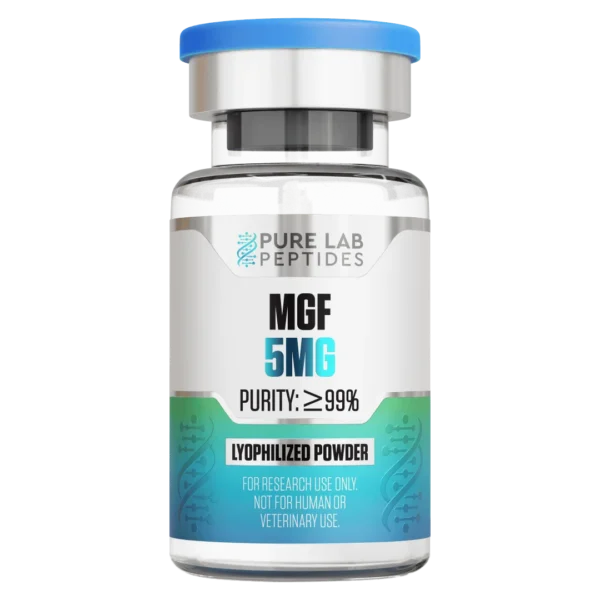
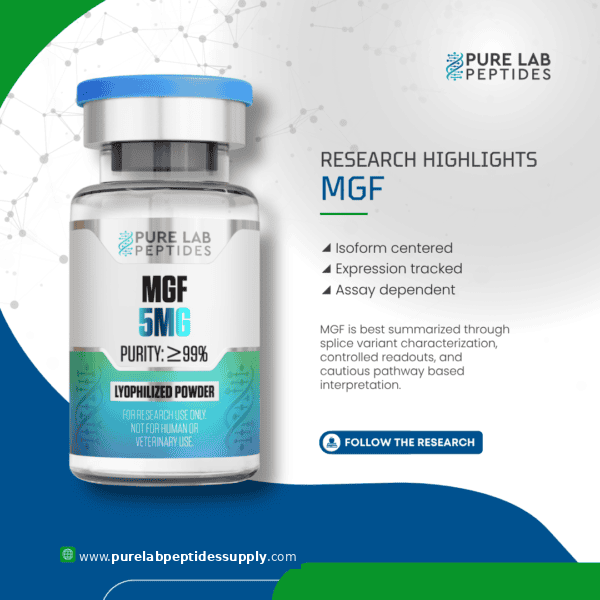
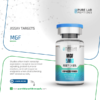
Explore MGF 5 mg from Pure Lab Peptides Supply, supplied as lyophilized powder in one boxed 3 mL vial for laboratory research.
MGF stands for mechano growth factor. In scientific literature, this name refers to the E-domain associated with an insulin-like growth factor-I (IGF-I) precursor and to related synthetic peptides. However, different MGF constructs may vary in sequence, length, and chemical structure. Therefore, researchers should identify the specific peptide before comparing experimental findings.
For product information and available batch documentation, visit Pure Lab Peptides Supply and the COA and document page.
Product Information
- Product name: MGF
- Labeled quantity: 5 mg
- Physical form: Lyophilized powder
- Packaging: One boxed 3 mL vial
- Full name: Mechano growth factor
- Research context: IGF-I precursor-related E-domain peptides
- Intended use: Laboratory research only; not for human or veterinary use
Match the Peptide to Your Research
A short MGF E-peptide, a complete IGF-I precursor, and mature IGF-I represent different molecular preparations. Although they are related in the scientific literature, they are not interchangeable. A study involving one form does not automatically establish the properties or activity of another.
For accurate comparisons, check the peptide sequence, length, and terminal chemistry against the experimental method. In addition, confirm the specific construct described in the relevant publication before applying its findings to a research material.
This listing also differs from PEG-MGF 2 mg, which identifies a polyethylene glycol (PEG)-conjugated material. PEG attachment introduces additional structural considerations. Consequently, the two products should not be compared by labeled milligram quantity alone.
Scientific Background: What MGF Studies Report
Findings in Human Muscle Cell Cultures
Kandalla and colleagues investigated a 24-amino-acid MGF E-peptide in primary human muscle cultures. Their study reported an increase in proliferative lifespan in cells from neonatal and young-adult donors, but not in cells from old-adult donors.
These findings describe a specific cell-culture experiment using a defined peptide construct. Therefore, they should not be interpreted as proof that every MGF-related preparation produces the same response or that the findings translate directly to a whole organism.
The study provides useful context for understanding how the experimental peptide and donor-cell characteristics can influence observed results.
Different Studies Report Different Outcomes
A later study by Fornaro and colleagues examined native and stabilized MGF peptides in muscle-cell systems. Unlike the earlier report, the researchers did not reproduce the proposed proliferation or differentiation effects under their tested conditions. Meanwhile, mature IGF-I and full-length IGF-1Eb comparators retained activity in those experiments.
These differing results highlight the importance of the specific peptide construct, cell model, and measured endpoint. Moreover, differences between experimental designs can affect whether findings are comparable across studies.
Researchers should therefore evaluate each publication according to the material and methods it actually describes. Neither study independently verifies the identity, purity, content, or biological activity of a commercial MGF batch.
COA and Batch Documentation
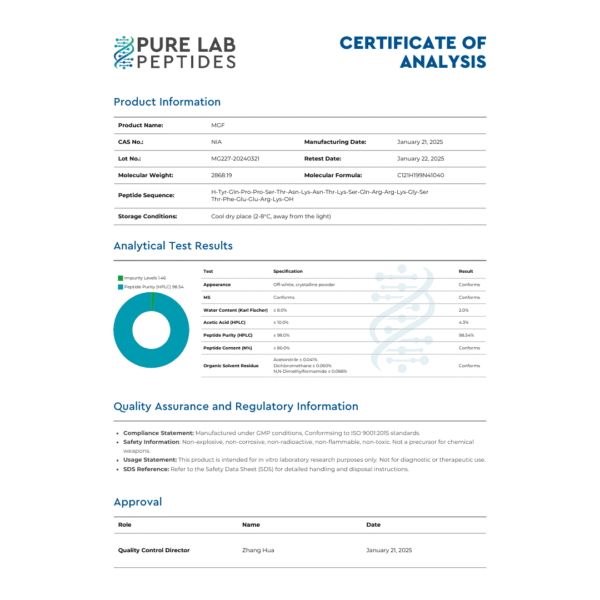
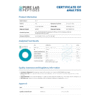
Before evaluating MGF 5 mg, review the available product files through the COA and document page. Match the product name and lot identifier, then check which analytical measurements the relevant report includes.
Identity, purity, and measured content answer different questions. For example, a chromatographic purity result alone does not establish the complete peptide structure or the total quantity of target material in a vial. Likewise, the MGF name does not independently identify every sequence or chemical modification.
For additional product information, visit Pure Lab Peptides Supply.
Packaging and Research Considerations
MGF 5 mg is described as lyophilized powder in one boxed 3 mL vial. The 5 mg label refers to the stated material quantity, while 3 mL describes the container’s capacity. Neither specification establishes a solution concentration or a preparation volume.
Researchers should follow the handling, storage, and analytical procedures applicable to the supplied form and their laboratory conditions. In addition, use the available product records to confirm the relevant material specifications before comparing results with published studies.
This product is intended for laboratory research only and is not intended for human or veterinary use.
Frequently Asked Questions
What does MGF stand for?
MGF stands for mechano growth factor. In published research, the term is associated with the E-domain of an IGF-I precursor and related synthetic peptides.
What does MGF 5 mg mean?
MGF identifies the research material by name, while 5 mg indicates the labeled quantity per vial. It does not specify a liquid concentration or experimental dose.
Is MGF the same as mature IGF-I?
No. MGF-related E-domain peptides, full-length IGF-I precursors, and mature IGF-I are distinct molecular preparations. Researchers should confirm the exact construct used in each study.
How does MGF differ from PEG-MGF?
PEG-MGF refers to a PEG-conjugated material. The added polymer introduces additional structural characteristics, so researchers should compare the specific chemical forms rather than relying on milligram quantities alone.
Where can I find the available batch documentation?
Visit the COA and document page to review available product files and reports. Always match the documentation to the product and lot being evaluated.
Research Documentation and Product Review
MGF provides a research term for investigating IGF-I precursor-related E-domain peptides. However, published findings can differ according to peptide structure, experimental model, and measured outcome. For that reason, researchers should distinguish scientific literature from batch-specific analytical evidence.
To review product information and available documentation, visit Pure Lab Peptides Supply and the COA and document page.