Description
Adipotide 10 mg | Pure Lab Peptides Supply
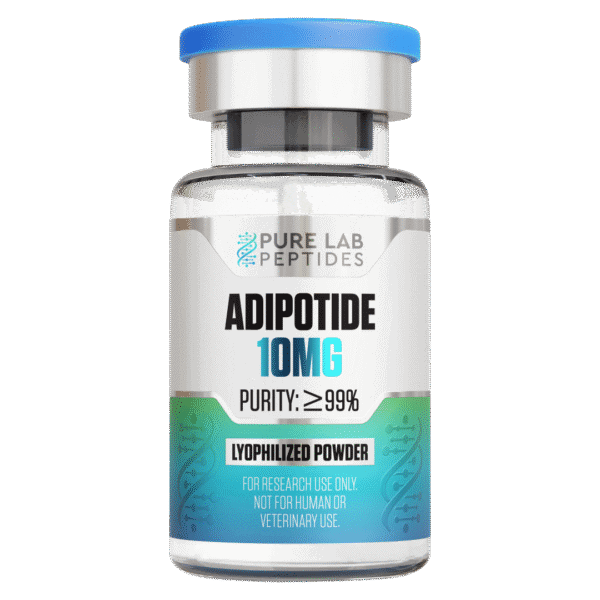
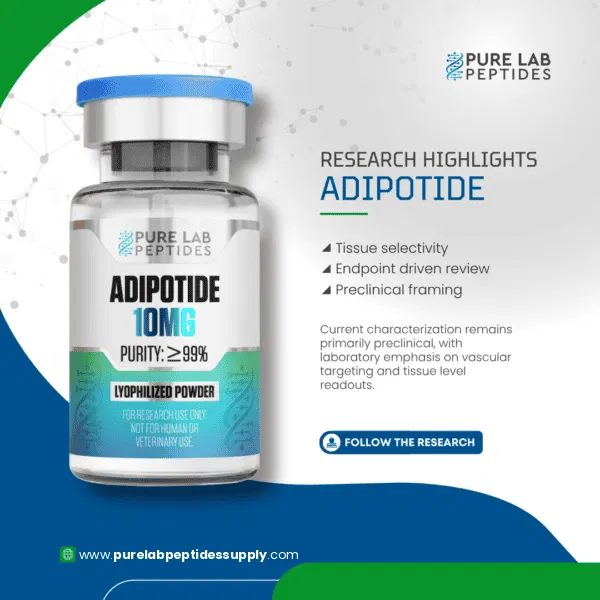
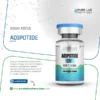
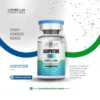
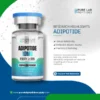
Buy Adipotide 10 mg from Pure Lab Peptides Supply. Each vial contains 10 mg of labeled research material in lyophilized powder form. This presentation supports laboratory research, peptide characterization, and analytical reference purposes.
Product Overview
Adipotide, also known as FTPP or Prohibitin-Targeting Peptide 1, is a synthetic chimeric peptidomimetic developed for research involving targeted molecular interactions. Its structure combines a targeting sequence with a second peptide segment designed to investigate cellular membrane interactions.
The commonly reported structure contains three sections: a cysteine-containing targeting sequence, a short glycine linker, and a D-amino-acid-rich pro-apoptotic domain. Together, these components form a specialized peptide construct rather than a conventional short peptide bioregulator.
Researchers have investigated Adipotide in experimental models involving white adipose tissue vasculature and prohibitin-associated molecular targeting. Furthermore, its design provides a research framework for studying targeted peptide delivery and cellular responses.
Pure Lab Peptides Supply offers Adipotide in a 10 mg presentation. Moreover, the lyophilized format provides a dry material form for laboratory inventory and appropriate storage. Importantly, the stated 10 mg represents the labeled mass of the material, not a concentration or prepared solution volume.
Product Information
| Specification | Details |
|---|---|
| Product name | Adipotide |
| Alternative designation | FTPP |
| Other designation | Prohibitin-Targeting Peptide 1 |
| Compound class | Synthetic chimeric peptidomimetic |
| Structural components | Targeting domain, glycine linker, D-amino-acid-rich domain |
| Reference sequence | CKGGRAKDC-GG-D(KLAKLAK)₂ |
| Peptide length | 25 residues in the commonly reported construct |
| Labeled quantity | 10 mg |
| Presentation | One vial |
| Physical format | Lyophilized powder |
| Product type | Research material |
| Intended application | Laboratory research and analytical reference |
| Documentation | Online COA access |
Molecular Characteristics
Adipotide has a more complex structure than conventional linear peptides. Its commonly reported architecture combines the CKGGRAKDC targeting motif with a glycine linker and a D-amino-acid-based peptide domain.
The reference sequence is:
CKGGRAKDC-GG-D(KLAKLAK)₂
The first nine residues form a cysteine-containing targeting domain. The two glycine residues provide a connecting segment. Meanwhile, the final domain contains repeated D-amino acid residues, which distinguish it from an entirely L-amino-acid peptide.
Commonly reported reference specifications include:
- CAS number: 859216-15-2
- Molecular formula: C₁₁₁H₂₀₄N₃₆O₂₈S₂ for the commonly reported disulfide-cyclized form
- Molecular weight: Approximately 2,555.2 g/mol for that form
- Reference sequence: CKGGRAKDC-GG-D(KLAKLAK)₂
- Structural classification: Chimeric peptidomimetic
- Targeting domain: CKGGRAKDC
- Linker: Gly-Gly
- Effector domain: D(KLAKLAK)₂
- Cyclization: Commonly reported disulfide linkage between the two cysteine residues
An important distinction concerns the cysteine linkage. The disulfide-cyclized structure has two fewer hydrogen atoms than the corresponding reduced form with free thiol groups. Consequently, the molecular formula and molecular weight may differ between reference records.
Salt forms and other chemical modifications can also change the reported specifications. Therefore, researchers should verify the exact molecular form against the supplied product documentation and applicable batch COA.
Understanding the Adipotide Research Classification
Adipotide belongs to a specialized category of synthetic peptide constructs designed to combine molecular targeting with a separate functional domain.
Its architecture includes two principal components:
- Targeting domain: The CKGGRAKDC sequence is associated with research into prohibitin-related targeting on white adipose tissue vasculature.
- D-amino-acid-rich domain: The D(KLAKLAK)₂ segment is a membrane-interacting peptide component investigated in cellular research.
The glycine linker connects these two sections. Furthermore, the cysteine residues in the targeting region can form a disulfide bond, creating a cyclic structure that influences the construct’s molecular configuration.
Research on Adipotide has examined targeted molecular interactions and experimental cellular responses. However, these findings should remain within their experimental context. They do not establish clinical safety, efficacy, or suitability for human use.
Adipotide is also structurally different from conventional metabolic peptides and short bioregulators. Its classification reflects a specialized chimeric peptidomimetic design rather than a simple receptor-signaling peptide.
Why Choose the Adipotide 10 mg Presentation?
The 10 mg presentation provides a clearly labeled quantity for laboratory inventory and material identification. In addition, the single-vial format helps researchers organize Adipotide alongside other specialized peptide research materials.
The lyophilized format offers a dry material presentation for appropriate laboratory storage. Moreover, the defined label quantity supports straightforward product identification when maintaining research records.
Nevertheless, the labeled quantity alone does not establish purity, molecular identity, or analytical performance. For this reason, researchers should review the applicable batch documentation before making material comparisons.
Quality Documentation and COA
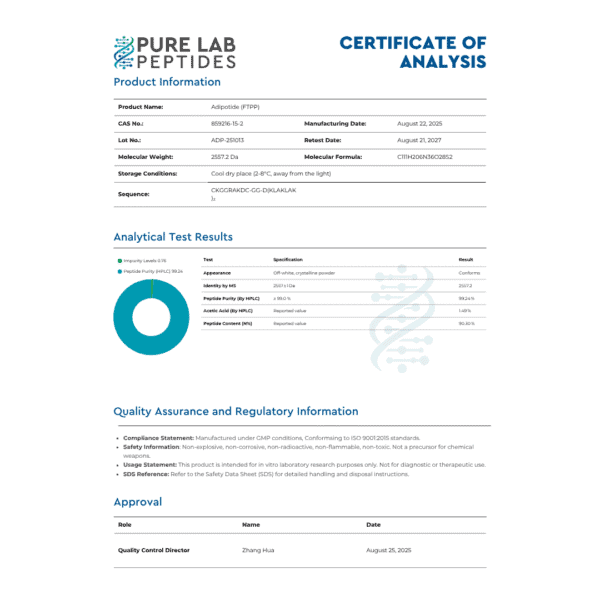
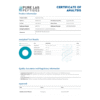
Product documentation helps researchers verify material identity and review available analytical information. For this reason, Pure Lab Peptides Supply provides access to its COA documentation page.
Visit the Pure Lab Peptides Supply COA page to review available documentation.
When reviewing a COA, check the product identifier and batch information carefully. Furthermore, compare the reported molecular mass with the expected structural form. For Adipotide, the cysteine disulfide linkage and any salt-related modifications are particularly important when interpreting molecular specifications.
Discreet Delivery with Pure Lab Peptides Supply
Pure Lab Peptides Supply prioritizes professional order handling and discreet presentation. To support customer privacy, eligible shipments use odor-proof, tamper-resistant, non-branded packaging.
Additionally, eligible orders include tracking information so customers can follow shipment progress. The exterior packaging avoids unnecessary product details. As a result, customers receive a professional and privacy-focused delivery experience.
Storage and Handling
Adipotide arrives as lyophilized powder. Therefore, follow the storage conditions stated in the applicable product documentation and COA.
Keep the vial properly sealed and protect the material from unsuitable environmental conditions. In addition, follow established laboratory handling procedures and applicable institutional requirements.
Because Adipotide contains a specialized peptide structure, researchers should also consult the relevant handling and stability information for the supplied formulation. Consequently, avoid assuming that storage recommendations for other peptide products automatically apply to Adipotide.
Frequently Asked Questions
What is Adipotide?
Adipotide is a synthetic chimeric peptidomimetic also known as FTPP or Prohibitin-Targeting Peptide 1. Its structure combines a targeting motif, a glycine linker, and a D-amino-acid-rich peptide domain.
What is the amino acid sequence of Adipotide?
The commonly reported sequence is CKGGRAKDC-GG-D(KLAKLAK)₂. It contains a cysteine-containing targeting region and a repeated D-amino-acid-rich domain.
What does FTPP stand for?
FTPP is commonly used as an alternative designation for Adipotide and refers to its fat-targeted pro-apoptotic peptide research design.
How much material does each vial contain?
Each vial carries a labeled quantity of 10 mg of dry research material. This figure represents material mass rather than solution concentration.
What is the molecular weight of Adipotide?
The commonly reported disulfide-cyclized structure has a molecular weight of approximately 2,555.2 g/mol. However, the reduced form and different salt presentations may have different molecular specifications.
What is the physical format?
Pure Lab Peptides Supply offers Adipotide 10 mg as lyophilized powder in one vial.
Is Adipotide a conventional linear peptide?
No. Adipotide is a chimeric peptidomimetic containing a cysteine-based targeting region and a D-amino-acid-rich domain. Therefore, its structural characteristics differ from those of many conventional linear peptides.
Where can I find COA documentation?
Visit the Pure Lab Peptides Supply COA page to access available documentation. Always check the relevant product and batch details when reviewing analytical information.
Order Adipotide 10 mg
Explore the Adipotide 10 mg listing at Pure Lab Peptides Supply. Each presentation contains one vial of lyophilized research material with a labeled quantity of 10 mg.
For additional product information, review the available documentation and COA resources. This way, you can compare the stated product specifications with the relevant analytical records.