

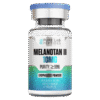





Melanotan II 10 mg Research Peptide | Pure Lab Peptides Supply
Product Overview
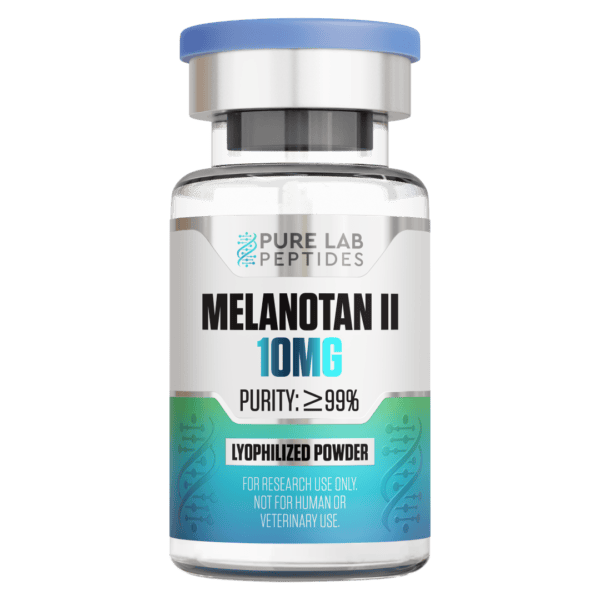
Explore Melanotan II 10 mg from Pure Lab Peptides Supply, supplied as lyophilized powder in one boxed 3 mL vial for laboratory research.
Melanotan II, also known as MT-2, is a synthetic cyclic peptide studied in melanocortin research. Its ring structure and chemical features distinguish it from related peptides. Therefore, researchers should confirm the precise molecular identity before comparing experimental findings or selecting a reference material.
For product information and available batch documentation, visit Pure Lab Peptides Supply and the COA and document page.
Product Information
- Product name: Melanotan II
- Alternative name: MT-2
- Labeled quantity: 10 mg
- Physical form: Lyophilized powder
- Packaging: One boxed 3 mL vial
- Peptide type: Synthetic cyclic peptide
- Research area: Melanocortin biology and structure-activity relationships
- Intended use: Laboratory research only; not for human or veterinary use
Why the Cyclic Structure Matters
The reference structure of Melanotan II contains a lactam bridge, a covalent link between amino-acid side chains that closes part of the peptide into a ring. This structural feature distinguishes it from linear Melanotan I.
Similarly, PT-141 is a related melanocortin peptide with different terminal chemistry. Although these compounds share aspects of their research background, their structures are not identical. Consequently, findings involving one peptide should not automatically be attributed to another.
When comparing materials, researchers should consider the amino-acid sequence, ring connection, terminal groups, and supplied chemical form. A short product name or residue count alone cannot establish that two peptides are equivalent.
Scientific Background: Understanding Structure-Activity Research
What Cyclic-Analog Studies Examine
A primary study of cyclic melanocortin analogs synthesized seven lactam peptides and compared their responses using frog-skin and lizard-skin bioassays. The researchers found that changes in ring size influenced measured activity, while the two assay systems did not produce identical potency relationships.
These findings illustrate the importance of molecular structure in peptide research. In particular, a structural modification can affect how a peptide performs in a defined experimental system.
However, relative potency in one bioassay does not establish a universal activity profile. Results may depend on the peptide structure, biological model, assay conditions, and endpoint. Furthermore, these experiments do not establish a human-use outcome or verify the purity and content of a commercial product.
Published research therefore provides scientific context, but batch-specific analytical records remain necessary when evaluating a supplied material.
COA and Batch Documentation
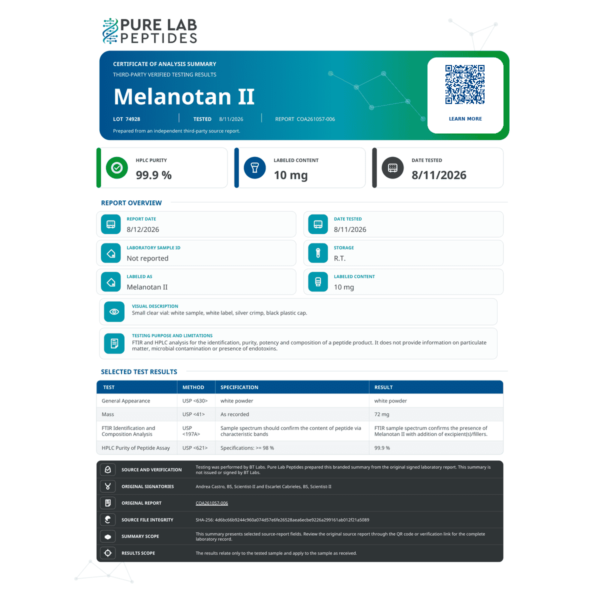
Before evaluating Melanotan II 10 mg, review the available product files through the COA and document page. Match the product name and lot identifier, then examine the analytical results documented for that specific batch.
Identity, chromatographic purity, and measured content are separate measurements. For example, a chromatographic purity result describes the sample profile under the method used; it does not independently establish the total peptide quantity in the vial or its biological activity.
Likewise, published studies on another analog or formulation do not verify the characteristics of this product. Therefore, researchers should assess batch records separately from published structure-activity findings.
For additional product information, visit Pure Lab Peptides Supply.
Packaging and Research Considerations
Melanotan II 10 mg is supplied as lyophilized powder rather than a spray or prepared solution. The 10 mg label describes the stated material quantity, while 3 mL describes the vial’s capacity. Neither specification establishes a solvent volume or resulting solution concentration.
Researchers should follow the applicable product documentation and laboratory protocols for handling, storage, and analysis. In addition, ensure that the reference material matches the compound and chemical form required by the experimental method.
This product is intended for laboratory research only and is not intended for human or veterinary use.
Frequently Asked Questions
What is Melanotan II?
Melanotan II, or MT-2, is a synthetic cyclic peptide studied in melanocortin research. Its cyclic structure is an important part of its molecular identity.
What does Melanotan II 10 mg mean?
Melanotan II identifies the peptide, while 10 mg indicates the labeled quantity of material per vial. It does not specify a liquid concentration or experimental dose.
How does Melanotan II differ from Melanotan I?
Melanotan II has a cyclic structure, whereas Melanotan I is a linear analog. Their structural differences mean researchers should evaluate them as distinct compounds.
Is PT-141 the same as Melanotan II?
No. PT-141 is a related but distinct peptide with different terminal chemistry. Shared research context does not establish that the two compounds are interchangeable.
Is this product a spray or liquid?
No. This listing describes lyophilized powder in one boxed 3 mL vial, not a spray or prepared solution.
Where can I find available batch documentation?
Visit the COA and document page to review available reports and product files. Confirm that the product and lot identifiers match the material being evaluated.
Research Documentation and Product Review
Melanotan II 10 mg provides a defined cyclic peptide identity for laboratory research into melanocortin biology and structure-activity relationships. However, researchers should distinguish published assay results from batch-specific analytical evidence and confirm the exact molecular form before making comparisons.
To review product information and available documentation, visit Pure Lab Peptides Supply and the COA and document page.